Debbie Kilroy

Articles

Article image placeholder

All the king’s men? A demographic study of opinion in the first English Parliament of James I, 1604–10

Parliaments, Estates and Representation

This article uses the digital humanities approach to analyse the first English Parliament (1604–10) of James I in an entirely new way. Utilizing the most comprehensive data on the parliament – the Journal of the House of Commons– and, through computer programming and database manipulation, integrating it with what is known of individual Members of Parliament (MPs), it explores the reactions of parliament-men en masse and by a number of demographic categories to some of the most important issues of James’s early reign: finance, religion, prerogative against privilege, the grievances of impositions, purveyance and wardship, and the Anglo-Scottish Union. In doing so, it shines new light on some of the biggest questions asked by historiography: who were the parliament-men of the first Jacobean Parliament, did they act in predictable ways, and can any of them be considered to represent some form – religious, ‘country’ or cultural – of ‘opposition’? Not only does it suggest some startling conclusions, reopening old debates with new insights, but it also provides another approach to our understanding of the crisis of the mid-seventeenth century, and to the history of parliaments as a whole.
Article image placeholder

Over-Throne: Parliament vs Charles I

Inside History

At the start of the seventeenth century genuine sovereignty rested in the monarch in parliament: the monarch was the head of the body politic, guiding but responding to the body, its subjects represented by the Lords and Commons. Yet within 50 years parliament had waged a bloody and brutal war against the king, executed him in front of a building that had been decorated in celebration of the divine right of kings, and abolished the monarchy. How, in such a short space of time, did parliament become powerful and confident enough to overthrow such a seemingly strong system?

Thumbnail for Monarchs Behaving Badly: James I and the Visit of Christian IV of Denmark

Monarchs Behaving Badly: James I and the Visit of Christian IV of Denmark

gethistory.co.uk

James I of England (and VI of Scotland) has not always had a good reputation. Known as ‘the wisest fool in Christendome’, he was considered slovenly, his tongue was reportedly too big for his mouth, making him both a messy eater and occasionally difficult to understand, and he took too personal an interest in people’s private affairs.

Thumbnail for Profligacy, Politics, and Plots: The Carews of Beddington

Profligacy, Politics, and Plots: The Carews of Beddington

Histories of the Unexpected

In 1630, Sir Nicholas Throckmorton-Carew gave his son, Francis Carew, a sound verbal beating. He berated him for his profligacy, recklessness, ‘stupified judgement’ and ‘proude and vayne mynde’. For Francis had fled the country to escape his creditors, carelessly leaving necessities – such as his watch and seal – behind, and then had the temerity to write to his wife to request that she send these along with his ‘uncutt velvett cloake, … clothe sute, with tow new bever hattes, and tow new payre of bootes,’ to him in France, ‘as though all Paris and France had not sufficient to furnishe’ him.

Thumbnail for The Cold Marital Bed of Samuel Pepys

The Cold Marital Bed of Samuel Pepys

Histories of the Unexpected

Samuel Pepys’s marital bed might often have been metaphorically cold, caused at least in part by his wife Elizabeth’s excruciatingly painful genital abscesses, but that didn’t stop him getting his jollies elsewhere when he could.

Article image placeholder

Waiting for War

Inside History

‘I resolved today to keep a diary of all my comings and goings; of personal affairs and world affairs; of any events that may be [of] interest to the world in general; of happenings that most certainly will be of interest to myself … I doubt if I will be able to keep this diary for a sufficient length of time for it to be useful, but what I do enter will most surely interest me when I read it. Perhaps it will recall some happy hours, let me live again some pregnant moments. And yet, perhaps it will cause old wounds to reopen, semi-forgotten sorrows to rear again their tormenting heads. However, I am firmly resolved to keep a diary – for some time at least.’

Thumbnail for The Essex Rising

The Essex Rising

gethistory.co.uk

On Sunday 8 February 1601 a group of armed men, perhaps 300 strong and led by the petulant earl of Essex, marched through London. Their attempted coup failed: London would not rise, the plotters had no leverage, and the court was forewarned. The last ‘great’ noble revolt against the crown and its advisers fizzled to an inglorious end, its perpetrators fined, imprisoned, or executed.

Thumbnail for Childhood in the World of John Dee

Childhood in the World of John Dee

Histories of the Unexpected

John Dee’s ‘diary’ provides a fascinating insight into many aspects of his life, but perhaps none more so than into his experience of family. The diary – more properly called an ephemeris – noted down the astrological positions of planets and constellations at the moment of particularly significant events in Dee’s life. So, for example, he recorded the times of his wife’s periods and of their intimate moments in order to calculate astrological charts for their children. And, because he saw the things he recorded as significant in some way, we can make an assumption about how important they were to him.

Thumbnail for Goodcole’s Speedie Hue and Cry

Goodcole’s Speedie Hue and Cry

Histories of the Unexpected

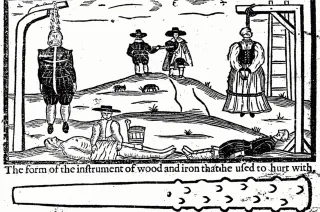
Henry Goodcole’s Heavens Speedie Hue and Cry Sent after Lust and Murther, printed over three editions in 1635, is an exemplary murder pamphlet not just for its popularity, titillating details, and gore, but because it shows the development of the real-crime genre and of society’s approach to the causes of criminality.

Thumbnail for A Puritan Lady: The Diary of Margaret Hoby

A Puritan Lady: The Diary of Margaret Hoby

Histories of the Unexpected

Lady Margaret Hoby, née Dakins, was an heiress and valuable commodity on the Elizabethan marriage market. Her first two husbands, Walter Devereux, the younger brother of the earl of Essex, and Thomas Sidney, brother to the poet Philip Sidney, both died early. Her third husband, the puritan MP Sir Thomas Posthumous Hoby, nagged her into marriage in 1596, aided, no doubt, by Margaret’s need to have someone represent her property interests in court.